













Residential Fire Suppression

Fixed and flexible kitchen fire suppression for restaurants, hotels, schools, hospitals and food outlets. Automatic protection over hoods, fryers and cooking lines, installed in a day or two and serviced twice a year.
Water mist or sprinklers: independent advice, design and installation
As a commercial fire suppression specialist, we design and install both water mist and sprinkler systems, so we can recommend what actually suits your building, budget and fire strategy.
LPCB-certified water mist nozzles and in-house compliance expertise
Our commercial water mist systems use LPCB-certified nozzles. Our in-house compliance team prepares statements of equivalence and works directly with fire engineers, approved inspectors and fire authorities.
Full BIM coordination in Revit and AutoCAD
We coordinate fire suppression design with M&E and other services using BIM, cutting clashes on site and helping consultants and main contractors keep projects on programme.
UK water mist manufacturer with nationwide installation
We’re a SafeContractor-approved, British manufacturer of water mist fire suppression systems, supplying, installing and maintaining commercial systems across the UK through our accredited network.
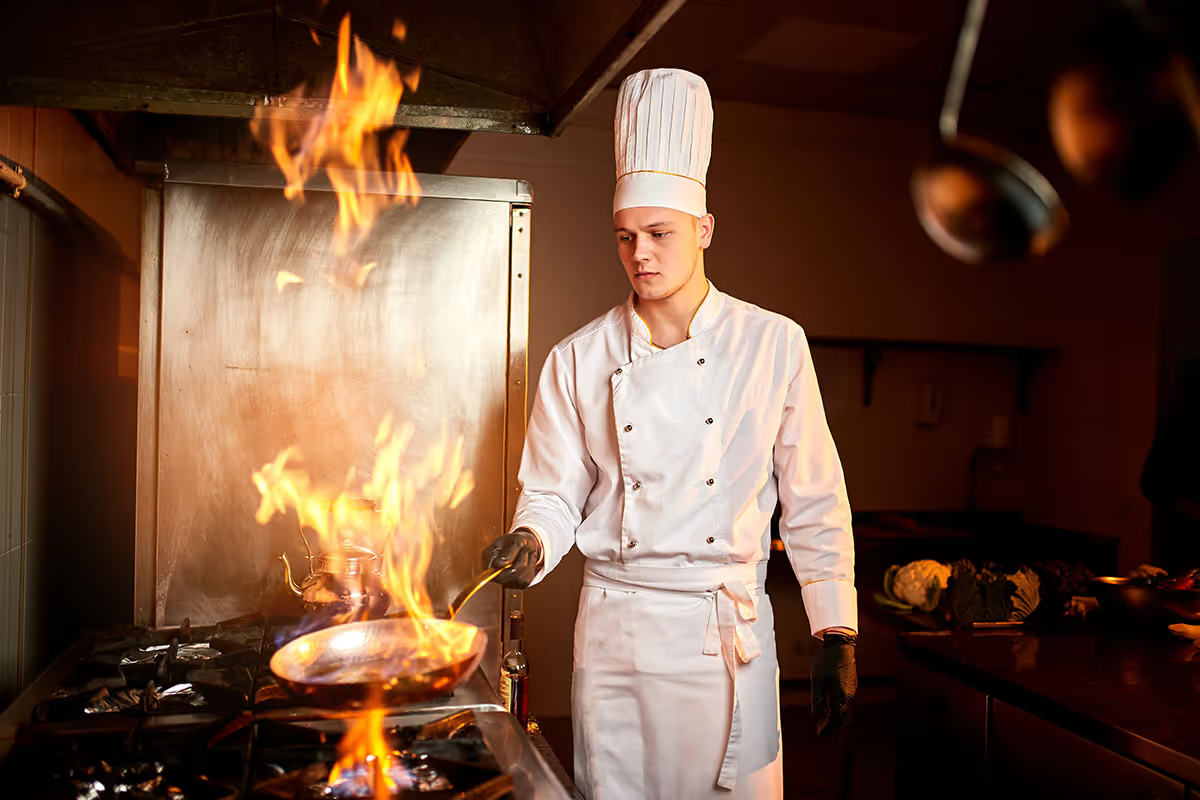
Kitchen fires start fast and spread through grease-laden extract ductwork. Insurers are tightening their standards, and a tested, automatic system over the cooking line is now expected in most commercial kitchens.
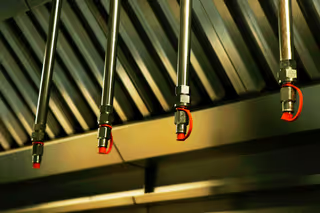
SmartMist designs, installs and services commercial kitchen suppression in partnership with Amerex. Fixed systems suit kitchens with a set appliance layout, such as food chains or ships. Flexible systems suit kitchens where equipment moves, with nozzles kept out of sight and no need to replace the system when the layout changes. Detection uses thermal and wire heat detection, and the system discharges a light foam solution that is easy to clean up.
Two sites with the same floor area can need very different systems. These are the factors we look at first.
Deep fat fryers and griddles can reach auto-ignition temperature. Oil fires need a tested agent, not water from a sprinkler.
Grease builds up in canopies and ducts and carries fire through the building. Suppression covers the plenum and duct as well as the appliances.
Fixed layouts suit a fixed nozzle design. Kitchens that move equipment need a flexible system that doesn't need redesigning every time.
Many insurers now ask for systems tested to UL 300, LPS 1223 or BS EN 17446, along with regular servicing and duct cleaning.
The system should cut the fuel or power supply to cooking appliances when it discharges, so the fire can't reignite.
Kitchens rarely close for long. Installation usually takes one day, sometimes two, and is planned around service.
UK law requires a fire risk assessment rather than naming a system, but insurers increasingly require automatic kitchen suppression tested to recognised standards.
The Regulatory Reform (Fire Safety) Order 2005 requires the responsible person to assess and reduce fire risk. In a commercial kitchen, automatic suppression is a common way to do that.
Insurers commonly expect systems tested to UL 300 or LPS 1223, and increasingly the European standard BS EN 17446, plus documented servicing.
Suppression works alongside regular extract cleaning. BESA's TR19 Grease is the specification most insurers refer to.
We install both, so we recommend whichever meets your design standard with the least water and plant space.
Water mist has a place in some kitchens: tested mist systems can protect commercial deep fat fryers, using fine droplets to cool the oil without spreading it. Most kitchen lines are protected with a dedicated kitchen system, and we'll recommend the right agent for each appliance.
Explore commercial water mist →Sprinklers protect the wider building but aren't designed for cooking oil fires over the line. Where your building has sprinklers, we make sure the kitchen system and sprinklers work together, and that the kitchen system cuts fuel to the appliances on discharge.
Explore commercial sprinklers →We start with a survey of your appliances, canopy and extract, then design a system to the cooking line and the agent each appliance needs. Systems are configured to the manufacturer's listing and your insurer's requirements.
Most installs take one day, sometimes two, planned around service. We test, commission and train your staff before handover.
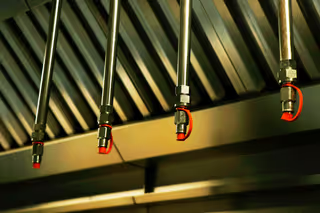
Nozzles over fryers, griddles, ranges and woks.
Coverage of the canopy, plenum and extract duct.
Thermal and wire heat detection with manual release.
Gas and electric isolation when the system discharges.
Which standard applies depends on the system, the building and, often, your insurer.
US fire test standard for kitchen fire suppression systems.
LPCB standard for fixed fire extinguishing systems for catering equipment.
European standard for fire extinguishing systems in commercial kitchens.
Water mist test protocol for commercial deep fat cooking fryers.
BESA specification for cleaning kitchen extract systems.
This page explains typical requirements. It isn't a fire strategy or design specification.
UK designed and built
Water mist and sprinkler systems
Commercial Kitchen, Kensington
In an ambitious expansion project, a popular gourmet burger chain on Kensington High Street extended their restaurant into the next-door property. This extension included a significant kitchen enlargement. SmartMist was selected to overhaul and upgrade the fire suppression system to ensure optimal safety in the expanded space.
Send drawings and the fire strategy. We'll confirm the likely system and design standard.
Layouts, hydraulic calculations and documents for your insurer and Building Control.
Planned around your build programme or operating hours.
Testing, handover pack and a maintenance plan from day one.
Commercial systems need an annual service, plus the routine owner checks the design standard sets. We test pumps and valves, check heads and nozzles for damage and obstruction, and provide the service records insurers expect. We also maintain systems installed by other contractors.
Service & maintenance plans →Most projects are quoted after a drawing review.
Read our cost guide →Heat detectors over the cooking line trigger the system automatically, or staff can release it by hand. Nozzles discharge a light foam solution onto the appliances and into the canopy and duct, and the fuel supply to the appliances is cut off. The foam is easy to clean up afterwards.
Usually one day, sometimes two, depending on the size of the kitchen. We plan the work around your service.
Typically twice a year. Insurers usually expect documented servicing alongside regular extract duct cleaning.
It can. Systems tested to recognised standards such as UL 300 and LPS 1223 are what most insurers look for. Check with your insurer, as each sets its own terms.
Yes, with a flexible system. Nozzles stay out of sight and the system doesn't need replacing when the layout changes.
Yes. We offer a full service including design, installation, commissioning, scheduled maintenance, compliance checks, and emergency support.
Yes. We can inspect, upgrade, and maintain existing mist or sprinkler systems to bring them in line with current regulations and performance expectations.
We plan every installation carefully to minimise disruption. Work can be phased or scheduled outside business hours to maintain normal operations where possible.
Our commercial water mist systems are designed to BS EN 14972-1, and our commercial sprinkler systems to BS EN 12845.
For residential projects, our sprinklers are designed to BS 9251. Our SmartMist DOME™ residential water mist system has met the performance criteria of the BS EN 14972-17:2025 open room fire test (3.5 m room height) at the FPA, a UKAS-accredited fire test laboratory, and every installation is designed to BS EN 14972-1. We also work to project and insurer requirements.
We assess your fire strategy, occupancy type, building design, and water supply. Based on this, we may recommend high-pressure mist, low-pressure mist, wet or dry sprinkler systems, or a hybrid approach.
Yes. SmartMist offers both advanced water mist systems and traditional commercial sprinkler systems. We recommend the most suitable option based on your building’s fire strategy, layout, risk profile, and water supply.
Send what you have. These help us quote faster:
Or call 0330 113 5900